More about Monsters

THIS POST CONTAINS SPOILERS FROM THE CAN’T MONSTER, SO YOU MIGHT WANT TO READ THE BOOK FIRST.

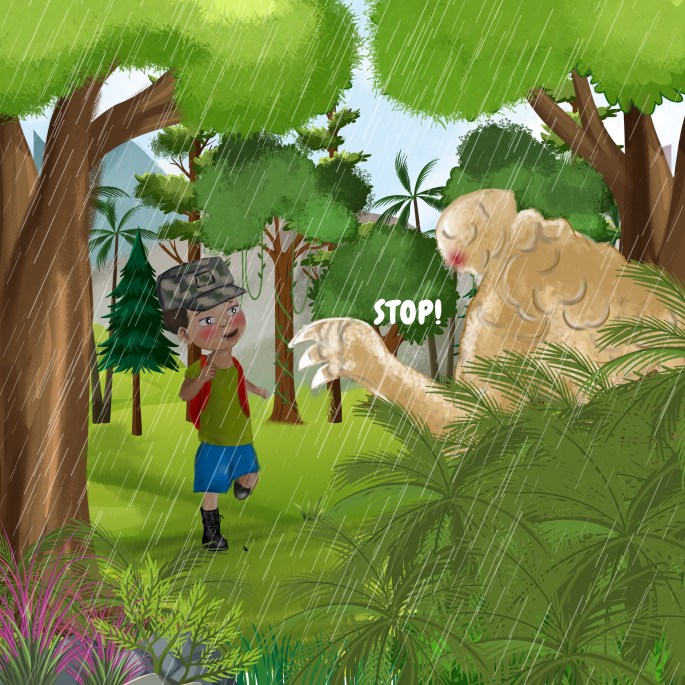
The monster in The Can’t Monster isn’t real. Will, the young boy who encountered the titular monster, realizes later in the story that the monster was all in his head. (How’s that for a spoiler?)

In a previous blog, I mentioned that the monster in my story represents the obstacles standing between an individual (or group) and his, her, or their own personal mountain. I’ll stand by that analysis, but I want to offer a corollary to it: monsters also represent excuses.

During one of my daily pre-predawn walks with Jack, our 130-pound Great Pyrenees, I recalled a conversation I had with a fellow soldier early in my Army days. This guy had tried, and failed, to become a Green Beret. He was not alone. A significant percentage of those who set out to be Green Berets, as Army Special Forces soldiers are known, do not make it through the long and often grueling assessment, selection, and qualification process. However, he had an interesting take on his own experience.

He told me that virtually everyone who washes out of Special Forces training has an excuse. That excuse almost always involves factors beyond their control. Seldom, he said, will anyone admit that they couldn’t hack it, or that it just wasn’t for them, when it’s easier to blame the cadre, the weather, their peers, an injury, or the fickle hand of fate.

By contrast, this guy offered no excuses for his failure. Instead, he moved on, made the most of his next-best alternative, and later attended Officer Candidate School. At last check, he had attained the rank of Major. He knew something about the Can’t Monster, and how an obstacle — real or imagined — can become an excuse, if you let it.

I was impressed with this fellow’s candor and maturity. It’s not that he didn’t face real obstacles, because I’m certain he did. But he did something that’s quite difficult for us humans: he owned his failure — and then he overcame it.

I should note that the process of becoming a Green Beret is so lengthy and difficult that I decided not to even attempt it, based on what I’d read about it prior to joining the Army. Fortunately, I was almost certainly a better fit for the military specialty that I ultimately selected. Still, a part of me still wonders if I could’ve made it through the course, had I possessed the guts to try.

And that’s what The Can’t Monster is about, in part: having the guts to try, and then to try again, if necessary. We all fall short of the mark at times. It’s how we deal with that failure that defines us. I have to remind myself of that on a regular basis.

Fun fact: In an earlier version of the story, I’d described Will’s father as “his Green Beret dad,” before changing it to, “his hero — his dad.”

Buy your copy today via Amazon or Barnes & Noble. FYI: the paperback measures 6.5″ square, whereas the hardcover edition is 8″ square.
Mountains, Monsters, and Metaphors

The Can’t Monster is a story about a boy who attempts to climb a mountain, fails, comes to terms with his failure, and tries again. Along the way, he encounters a monster that [SPOILER ALERT] turns out to be imaginary. The mountain and the monster are both plot devices with a symbolic meaning worth exploring.

During the considerable lulls in the publication process, I found myself pondering the significance of the symbols I employed in my story. I wondered if anyone else would pick up on them, or if they’d just take the story at face value. After all, The Can’t Monster is fundamentally a children’s book, not a contender for the title “Great American Novel.” Also, when it comes to the use of symbols, I’m not exactly Herman Melville (although, unlike Moby Dick, my book can be read in a matter of minutes, not over the course of several fortnights). Still, it’s worth discussing what the mountain and the monster in The Can’t Monster represent.

Here’s my take: the mountain is the thing to be achieved and the monster is the thing that stands in the way of achieving it. In the story, the mountain is a mountain. In life, a mountain can be a major life goal (a college degree, for example) or a lesser pursuit (a hobby, an adventure, a significant purchase, a project, etc.).

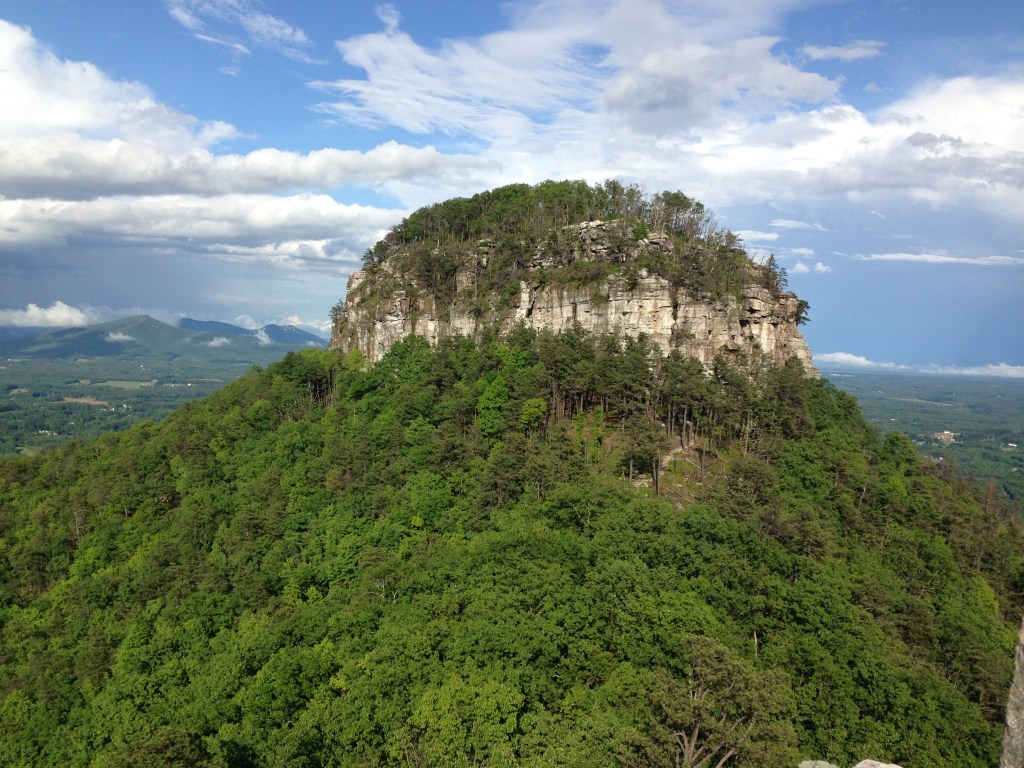
As a teenager, two friends and I ascended to the top of nearby Pilot Mountain from its base (as high as legally allowed, that is). It felt like quite the feat at the time. Today, that quest seems like a fairly leisurely hike. It’s not that I’ve climbed steeper or taller mountains since, because I haven’t. I’ve just accomplished things that are a lot more meaningful to me. Along the way, I’ve encountered many monsters.

In 1990, Pilot Mountain, a famous landmark in northwestern North Carolina, was the “thing to be achieved” for me and two of my buddies.

Most recently, the process of publishing a children’s book represented a mountain. I wouldn’t exactly consider it my own personal Mount Everest, since my livelihood doesn’t depend on its success, and my investment of time was relatively modest (compared to most book projects), but this doesn’t mean that I didn’t run into a few monsters along the way.

The first of these was the submissions process. Not all book publishers take unsolicited submissions. Those that do tend to respond only when they’re interested enough in the project to offer a book deal. Would-be authors typically don’t get rejection notices…they just wait, wait, and then wait some more before giving up. I went through this with The Can’t Monster and am currently going through it again with a follow-on project. The late Tom Petty spoke for all authors and prospective authors when he said that the waiting is the hardest part.

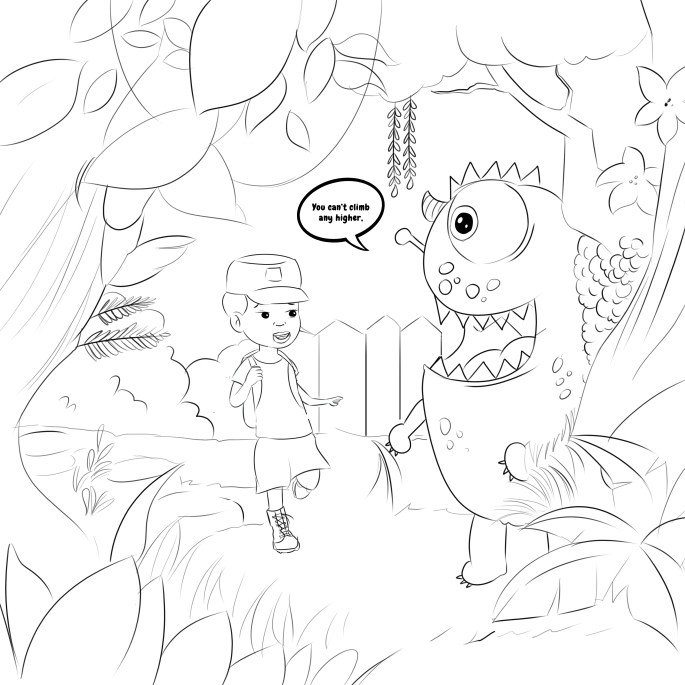
Once I found a publisher, new monsters appeared. One of these was the process of trying to determine what the monster in the story should look like, given that it didn’t really exist. Limited to communicating with the illustrator through an intermediary at the publisher, I quickly grew frustrated. We went through four of five iterations of the monster before arriving at something I could live with. Getting some of the other illustrations right presented lesser, but still noteworthy, challenges. Eventually, I made peace with the idea that, for the book to ever see the light of day, I had to make some compromises. The great, it turned out, was once again the enemy of the good enough.

This early rendering of the monster didn’t exactly fit my vision, nor did the next several versions.

The monsters mentioned above were not enough to deter me from reaching the top of this one metaphorical mountain (i.e., publication). Had I allowed these obstacles (among others) to deter me, then The Can’t Monster would have won. If so, my unpublished story would hold a uniquely ironic significance for me, and for me alone. Fortunately, in this case, I successfully stared down the monster.

As Will discovers in The Can’t Monster, most of the monsters I’ve encountered throughout my life have been in my head. I’d like to be able to report that I’ve prevailed in each of these confrontations. The truth is that my track record remains quite mixed.

I suspect that yours might be, as well. That’s how life tends to be: to avoid the monsters, we end up avoiding the mountains. The Can’t Monster prefers it that way. Don’t let it win.

Buy your copy of The Can’t Monster today via Amazon or Barnes & Noble. FYI: the paperback measures 6.5″ square, whereas the hardcover edition is 8″ square.

Publication Day!

Today is the day! Fifteen months after signing a publishing contract, more than two years since I first put pen to paper, and almost seven years after the moment of inspiration, The Can’t Monster is now officially on the market.

This occasion represents a victory over a personal “can’t monster” of mine, which has been seeing a book project through to completion. It was a long and at times tedious process, even though the book itself is quite short.

A heartfelt thanks goes out to everyone who helped make this happen, from the folks at Olympia Publishers and Bumblebee Books, the freelance editors and authors I contacted via reedsy.com, the friends who provided thoughtful input and advice and, of course, my loving wife, for her continuous support and encouragement.

Here are some ways to buy your copy:

Olympia Publishers (Paperback or Hardcover) Note: This appears to be the slowest option.

Amazon (Paperback or Kindle)

Barnes & Noble (Paperback or Hardcover)

Enjoy!

Chris