To My Chagrin

Merriam Webster defines chagrin as “disquietude or distress of mind caused by humiliation, disappointment, or failure.”

It’s a useful word, to be sure, but it doesn’t seem to belong in a children’s picture book. Yet, that’s the word I chose to describe my protagonist’s emotional state, following his failed quest. Why?

It’s pretty simple, really: I needed a word that rhymed with “again.”

For context, it helps if you understand that The Can’t Monster is a rhyming children’s book. There’s no good explanation for why I chose to go in this direction, except that’s how the first stanza of the story flowed from my sleep-deprived mind in early 2021.

A young boy named Will
gazed up at the hill
that loomed beyond Ol’ Muddy Creek

He said to that hill,
“Climb you, I will,
And view the whole world from your peak.”

With those words, I was off to the races. The first draft of the story was full of iffy, and sometimes forced, rhymes (among other problems), but the specific conundrum that led me to use the word “chagrin” didn’t happen until later, after I decided that Will’s father should return in time for the story’s climax. The father would demonstrate empathy with his son by telling Will that “he knew this Can’t Monster too, [and] faced him too often to mention.”

In an earlier draft, I attempted to rhyme “misadventure” with “mention.” Needless to say, that didn’t work. I had no luck in my attempt to find a suitable stand-in for either of these words. Once I realized that I’d used “mention” a few stanzas earlier, I knew it had to be replaced. Unfortunately, there isn’t a lot that rhymes with “misadventure.”

I substituted “again” for the duplicate use of “mention” and was satisfied with the result, but this didn’t get me any closer to a workable rhyme. Consequently, I spent a fair amount of time on the website RhymeZone.com — to no avail. Then, for reasons I’ve since forgotten, I decided to look up the definition of chagrin, finding the one provided at the top of this entry.

Not only did it work as a rhyme for “again,” it captured what I wanted to convey perfectly. Will was distressed and humiliated by his failure. However, I couldn’t help but wonder if early readers would know what this word meant.

They almost certainly will not, but I’m rolling the dice that this will not present an obstacle to understanding or enjoying the story. Readers young and old may be able to deduce the meaning of chagrin from context, or they might just blow right past it. Either way, they’ll end up in the same place — which [SPOILER ALERT] just happens to be at the top of a hill that looms beyond Ol’ Muddy Creek.

I’ll only regret my decision to use “chagrin” if, for whatever reason, it’s the reason someone doesn’t finish, or enjoy, the book. As unlikely as that seems, it would certainly be to my own personal chagrin if it did work out that way.

Chris

Buy your copy of The Can’t Monster today via Amazon or Barnes & Noble. FYI: the paperback measures 6.5″ square, whereas the hardcover edition is 8″ square.
Publication Day!

Today is the day! Fifteen months after signing a publishing contract, more than two years since I first put pen to paper, and almost seven years after the moment of inspiration, The Can’t Monster is now officially on the market.

This occasion represents a victory over a personal “can’t monster” of mine, which has been seeing a book project through to completion. It was a long and at times tedious process, even though the book itself is quite short.

A heartfelt thanks goes out to everyone who helped make this happen, from the folks at Olympia Publishers and Bumblebee Books, the freelance editors and authors I contacted via reedsy.com, the friends who provided thoughtful input and advice and, of course, my loving wife, for her continuous support and encouragement.

Here are some ways to buy your copy:

Olympia Publishers (Paperback or Hardcover) Note: This appears to be the slowest option.

Amazon (Paperback or Kindle)

Barnes & Noble (Paperback or Hardcover)

Enjoy!

Chris

Will, I Am

Will, the protagonist of The Can’t Monster, is based on me…sort of. Allow me to explain:

The Can’t Monster isn’t a true story, and yet it’s a story that is very real to me. My various attempts to climb mountains, more figurative than literal, have tested my courage, my perseverance, and my resilience. Along the way, I’ve succumbed to fear, frustration, and a sense of powerlessness (futility, for the sake of alliteration) more times than I’d like to admit.

Fear — the fear of failure, in particular — has kept me from trying things that could have been rewarding. Frustration, a near-constant companion, has convinced me to give up on ventures great and small. The recurring thought that I’m too small, too weak, and/or too unimportant to affect meaningful change has prevented me from reaching my potential.

All of these are common, and sometimes justifiable, feelings. However, a resilient person can deal with them and keep them in perspective. When the Can’t Monster is calling the shots, perspective is lost. Even minor obstacles begin to seem insurmountable. Hope wanes, and self-confidence falters.

“If things are bad and can’t get better, then why keep going?”

“Why try, if you’re destined to fail?”

“Why fight, if you know you can’t win?”

I’ve heard this voice too many times. The Can’t Monster wins when “fight or flight” is reduced to just flight. Giving up is not just the best option, the monster says, but the only viable one.

At a critical juncture in The Can’t Monster, Will listens to this voice. Soaked by the rain, fatigued by the climb, and pricked by briars, he decides to turn back. Most of us would, too, if in his shoes.

But when he gets home, he doesn’t want to own up to his own failure. Instead, he relates a fantastical tale of a menacing monster who compelled him to give up his quest. Admitting that we’ve been overcome by adversity, or that we just fell short of the mark, is tough.

This makes Will relatable. It really doesn’t matter if Will truly believed he saw a monster, or whether he just made it up. The important thing is that he blamed the monster for his decision to turn back.

The Can’t Monster provides a convenient excuse for our failure, or for not even trying something in the first place. It takes more than a little maturity to acknowledge that the Can’t Monster is in your head — and mine.

I don’t judge Will for giving up. Rare is the person who has never been overwhelmed by circumstances or deterred by obstacles. For most of us, quitting is a part of life. It just shouldn’t be allowed to define our lives.

Where we can all be inspired by Will is that he didn’t sit in his room and cry. He reflected on what had happened that day. By doing so, he realized that he’d lost his nerve…his will. I’ve been there.

Then, with help from his father, he did something about it. That’s the difficult part, and it’s one of the reasons I was determined to see this project through. We can all benefit from the reminder that the Can’t Monster only wins if it undermines our willingness to try –.and then to try again, and again, and again, if necessary.

Chris

Buy your copy today via Amazon or Barnes & Noble. FYI: the paperback measures 6.5″ square, whereas the hardcover edition is 8″ square.
Who Needs Parents?

Note: This post contains spoilers.

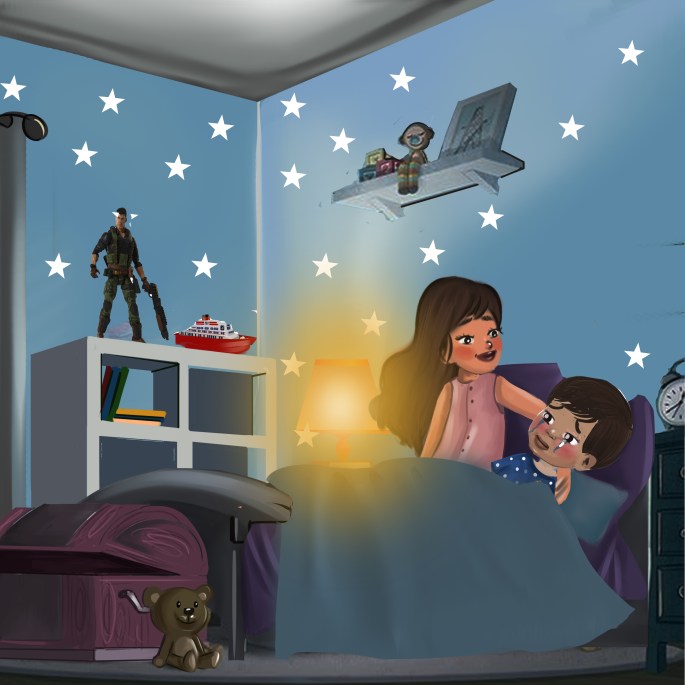
Some of my favorite illustrations in The Can’t Monster show Will and his mother. She sees him off on the day of his adventure. She’s waiting for him on the porch as he slinks home, dejected. She embraces him once he’s safely inside their home. She’s at his bedside when he begins to realize that the monster he saw, “was no monster at all.”

Will’s father is equally important to the story. One of Will’s motives for undertaking his quest is to prove to his father, who is away at the time, that he can do it. When his father returns, he comforts Will by telling him of his own encounters with the Can’t Monster. With his father at his side, Will finds redemption.

Will’s mother and father are absolutely integral to the story. — so much so that it’s quite difficult to imagine the story without them. Yet, somehow, that’s how it was at first.

As initially written, the parents were present only for the interrogation scene that takes place after Will returns from his adventure. They do not show any obvious sympathy for their son. Instead, they pepper him with questions in an attempt to figure out what their son really saw out on that hillside, if anything.

One reason I decided to include the parents as separate, distinct, and sympathetic characters was to help me resolve a nagging question I had about my own story: Did Will just head out on his own, or did he get his parent’s permission? If the latter, then why did his parents agree to let him go?

This is where the military dad comes into play. His absence provides motivation for Will to undertake his quest, but it also explains why his mother allowed him to do it. She “knows the pride he will feel” if only he can tell his absent father about his adventure. This was as far as I got in the second draft.

Then, I realized that, if the father returned, he could help Will work through his emotions by demonstrating empathy. Originally, the lesson of the Can’t Monster was explained by the narrator. Instead, I thought, why not let the father do it?

Finally, in a moment of inspiration, I decided that, if the father really wanted to help his son overcome the Can’t Monster, then they needed to climb the hill. And climb it, they did.

Upon finishing my first draft, I’d thought I’d written a poignant story about a boy who learned to deal with failure. By the final draft, I felt like I had a far more robust and compelling story, due to the addition of the parents. Will still deals with failure, but he has a much better support system in place.

Buy your copy today via Amazon or Barnes & Noble. FYI: the paperback measures 6.5″ square, whereas the hardcover edition is 8″ square.

What’s in a Name?

By the time I’d finished drafting the story that would become The Can’t Monster, it seemed impossible that my protagonist could be named anything other than Will. After all, the word “will” effectively describes the traits the character embodies.

Of the various definitions of “will” provided by Merriam-Webster, these seem most fitting:

Noun:

  1. used to express determination, insistence, persistence, or willfulness;
  2. used to express capability or sufficiency

In fact, near the story’s end, I use the common expression, “where there’s a will, there’s a way” because it tied directly back to the main character’s name. I like the fact that, if someone asks what my book is about, I can say it’s a “story about will,” knowing that is an accurate statement in two respects.

The irony is that I did not the select the name “Will” for this reason. Instead, I chose Will because in rhymes with “hill,” thus completing the first couplet of the story. I could’ve just as easily have selected Bill, Phil, or Jill (among others). The story would’ve followed the same arc if I had, and arrived at the same climax, but it’s almost unthinkable, in hindsight, that Phil would’ve stood atop the hill, triumphant.

I suppose the lesson learned is that sometimes it matters what’s in a name.

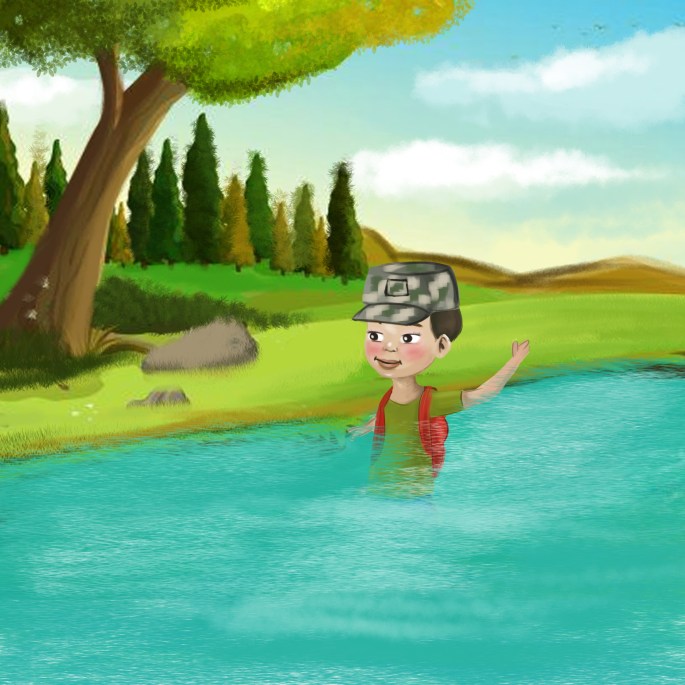
Young Will, the protagonist of The Can’t Monster, is seen here wading across a nearby creek early in his adventure. Things only get harder from here.

Order your copy of The Can’t Monster at Amazon.com or at https://olympiapublishers.com/book/the-cant-monster.

Why “The Can’t Monster?”

The Can’t Monster resulted from numerous streams of inspiration stretching across many years. The title of the book, however, was the product of a single moment in May 2016.

I spent several weeks in the spring of 2016 developing a proposal that I believed would improve the efficiency and productivity of my office. I bounced the ideas off a coworker and then shared it with my immediate supervisor, finding him quite receptive. He arranged a meeting to discuss the proposal with our entire team. The day of the meeting had arrived, and I expected the worse.

The night before, I’d mentioned to my fiancée (now wife) that I was dreading the meeting. I’d only been a part of the team for a year and a half, but that was long enough to get a feel for my coworkers and the overall power dynamic within the office. This knowledge led me to expect resistance to my proposal from one, if not more, of my colleagues.

Much to my surprise, the meeting started off quite well. All but one of my teammates were present, and all in attendance seemed amenable to my ideas. Our discussion was both amicable and productive. You could’ve knocked me over with a feather.

About forty-five minutes into the meeting, the one absent member of the team arrived. He stood in the back of the room and peered across the conference table at the large digital display on the far wall. Then he spoke. Within seconds, he’d confirmed why I’d been dreading the meeting since the moment it was scheduled.

Lacking any context for understanding what he was looking at, having missed the preceding forty-five-minute discussion, he emphatically pronounced the plan unworkable. The next ten minutes or so were a blur. The team leader, an Army officer, and a few others mounted a full-throated defense of my handiwork. I was not one of them. I knew that nothing good could come from it. I just wanted to hide under the table.

Once the meeting was over, I returned to my desk. I found an email from my fiancée inquiring about my day and, specifically, how the meeting had gone. I explained that the discussion had been unexpectedly positive, right up to the point that the latecomer arrived. After that, everything went downhill (and fast). I concluded with something very close to the following, “I really like [this coworker], but he’s the Can’t Monster.”

Her reply: “There’s your million-dollar idea.”

We’ll see about that, but she was right that I had a promising book title, and perhaps the beginnings of a book concept. After a few false starts, I finally started making headway almost five years later, in February 2021. Two long years later (and anyone who has ever published a book knows how slow the process can feel), and nearly seven years since the moment of inspiration, I’m proud to announce that The Can’t Monster is now for sale (preorder, that is).

Buy your copy today via Amazon or Barnes & Noble. FYI: the paperback measures 6.5″ square, whereas the hardcover edition is 8″ square.

Almost Heaven

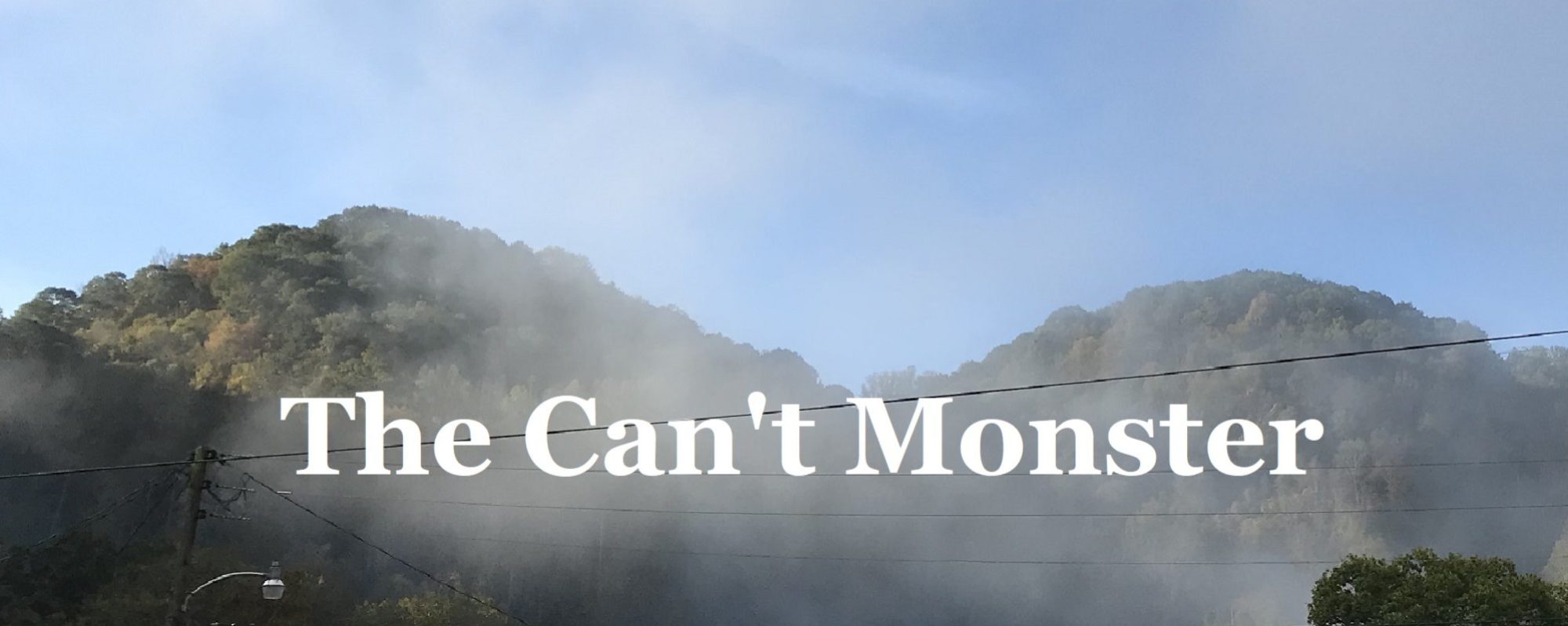
I had a difficult time selecting a header image for this website. I knew that I wanted to feature a mountain scene, since my story is about a young boy who endeavors to climb a mountain. The problem was that I had too many of these photos saved on my laptop to pick from. Here’s why I chose the one you see above.

This particular photo was taken from the driveway of my wife’s childhood home in Corinne Bottom, West Viginia. Her father was fond of sitting behind his house, watching birds and taking in the natural beauty. It’s easy to see why.

These rugged mountains provided inspiration for my first children’s book: The Can’t Monster. While visiting my father-in-law, I’d look out the window and see these steep hills rising in any given direction. I knew that, had I grown up there, I’d have found the urge to climb them irresistible. That impulse gave birth to Will, the main character in The Can’t Monster.

I wrote much of Will’s story from Corinne Bottom in early 2021. By that point in time, my father-in-law was sick. We were there to both visit and take care of him. He lost his battle with cancer that July. In doing so, he traded his quiet slice of “almost heaven” for the real thing. The Can’t Monster is dedicated to his memory.

Chris

Buy your copy today via Amazon or Barnes & Noble. FYI: the paperback measures 6.5″ square, whereas the hardcover edition is 8″ square.